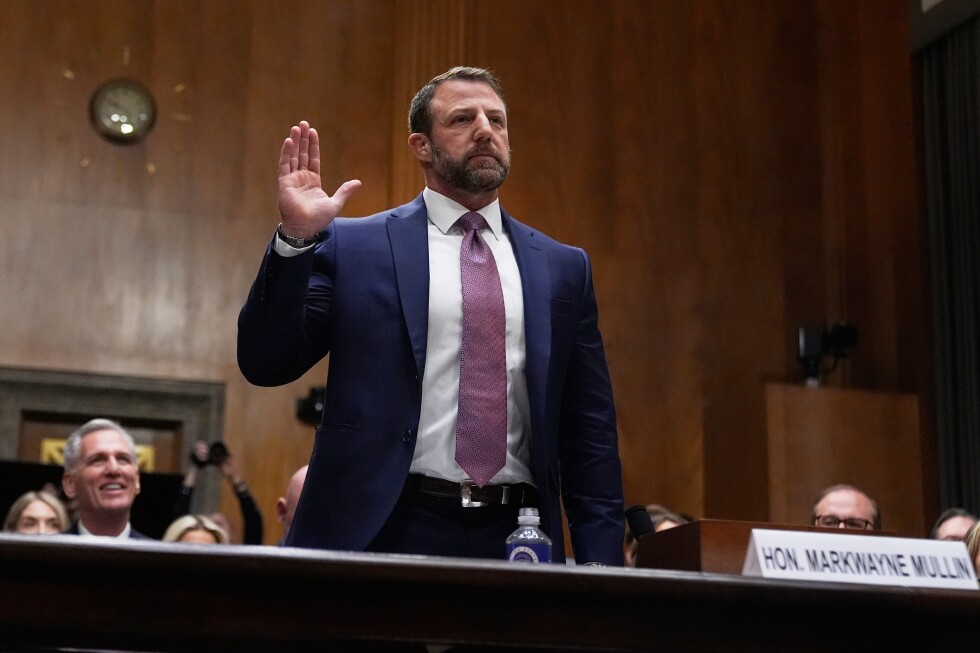
Markwayne Mullin's DHS Challenge: Fixing a Furloughed Agency
The Department of Homeland Security (DHS) stands at a critical juncture, an essential federal agency currently hobbled by a significant shutdown, leaving over 100,000 employees furloughed or working without pay. Into this maelstrom, President Trump has nominated Senator Markwayne Mullin to take the helm as DHS Secretary. His impending
markwayne mullin confirmation hearing is not just another political formality; it's a high-stakes audition for a leader tasked with stabilizing a vital agency, navigating complex political waters, and addressing a host of national security challenges. From agency management to contentious policy debates, Mullin faces an uphill battle, scrutinizing his past conduct, policy stances, and temperament under immense pressure.
The Furloughed Agency: A Crisis Awaiting Leadership
The current state of the DHS is nothing short of a crisis. With a substantial portion of its workforce either sent home or forced to work without compensation, the department's ability to fulfill its multifaceted mission is severely compromised. This isn't merely an inconvenience; it's a direct threat to national security and public safety. The shutdown stems from an impasse where Democrats are pushing for significant changes in how immigration officers operate, highlighting the deep political divisions embedded within the agency's core functions.
It’s crucial to understand that the impact of this furlough extends far beyond immigration enforcement. DHS is a sprawling entity encompassing critical components like the Transportation Security Administration (TSA), responsible for air travel security, and the Federal Emergency Management Agency (FEMA), which handles disaster response. A furloughed TSA means potential delays and security vulnerabilities at airports, while a hampered FEMA could have dire consequences during natural disasters. The morale of these dedicated public servants, many of whom are working without knowing when their next paycheck will arrive, is undoubtedly low, affecting productivity and long-term retention. A new Secretary's immediate priority would be to resolve this shutdown, restore operational capacity, and rebuild employee trust. This requires not just political negotiation skills but also exceptional leadership to unify a dispirited workforce and refocus them on their essential duties. The challenge for Mullin is not just to "fix" the agency, but to fundamentally re-energize it amidst a deeply partisan environment.
Navigating the Confirmation Gauntlet: Ethics, Rhetoric, and Senate Scrutiny
The path to a successful
markwayne mullin confirmation is rarely smooth, and Mullin’s journey has already hit some significant bumps. His ethics track record from the previous year is expected to draw sharp questions from the Senate Committee on Homeland Security and Governmental Affairs. Such scrutiny is standard for high-level appointments, but Mullin’s past has provided particularly fertile ground for critics.
One of the most notable confrontations during his hearing involved a heated exchange with fellow Republican Senator Rand Paul of Kentucky. Paul, who chairs the very committee tasked with approving Mullin’s nomination, directly challenged Mullin's conduct and "violent rhetoric." Paul, recounting a personal experience of violence that left him with severe injuries, passionately urged leaders to "disavow violence and lead by example." He then angrily charged that Mullin had "went on to brag that you'd already" engaged in violent behavior. The tension escalated as Paul detailed a recent interaction where Mullin, after voting against a measure related to refugee welfare programs, allegedly described Paul as a "thug."
Mullin, in his defense, addressed Paul directly: "I'll come straight to you. I'll say it publicly and I'll say it privately, but I'll never say it behind your back." He acknowledged their strained relationship, stating, "We just don't get along, however, sir, that doesn't keep me at all from doing my job." In an effort to diffuse the situation, Mullin appealed to Paul, saying, "Let me earn your respect. Let me earn the job. I won't fail you. I won't back down from a challenge. And I also admit when I'm wrong." This direct, albeit tense, exchange highlights the personal and political hurdles Mullin must overcome. For more on this confrontation, read
Rand Paul Confronts Mullin on Ethics at DHS Confirmation Hearing.
A nominee's temperament and ability to maintain decorum are crucial for a cabinet position, especially one as sensitive as DHS Secretary. The committee’s approval is essential before a full Senate vote, and while a nominee typically needs only a simple majority in the Senate, dissent from even a few Republicans could jeopardize Mullin’s prospects. His challenge is to convince senators, particularly those concerned about his past rhetoric, that he possesses the gravitas, judgment, and unifying spirit required to lead such a critical department.
The Shifting Sands of DHS Leadership: Context of Mullin's Nomination
Mullin's nomination doesn't occur in a vacuum; it follows a period of significant turbulence and leadership changes at DHS. President Trump’s decision to tap Mullin came after he announced the removal of DHS Secretary Kristi Noem, instead appointing her as Special Envoy for The Shield of the Americas, a regional coalition of Latin American countries. This change marks Noem as the first Cabinet secretary to depart the administration in Trump's second term, underscoring the challenges inherent in leading the department.
Noem's tenure was marked by controversy and bipartisan criticism. The department faced intense scrutiny for an immigration enforcement surge in Minnesota, which not only led to widespread protests but also tragically resulted in the deaths of two U.S. citizens. Her handling of these deaths, along with broader oversight of immigration enforcement, departmental spending, and management of disaster relief efforts, drew fire from across the political spectrum.
This turbulent backdrop provides critical context for Mullin's challenge. He isn't just stepping into a vacant role; he's stepping into a department reeling from recent operational failures, public backlash, and persistent political infighting. Beyond resolving the immediate furlough, Mullin would inherit a legacy of contentious immigration policies and the immense task of restoring public confidence in DHS's operational integrity and humanitarian responsibilities. He will need to demonstrate a clear vision for the department, a willingness to engage with diverse stakeholders, and the capacity to learn from past mistakes if he hopes to succeed where others have struggled. The role demands not just a strong hand, but a nuanced understanding of domestic policy, international relations, and human rights.
Oklahoma's Political Ripple: The Senate Seat Vacancy
Mullin's potential ascent to a cabinet position creates a significant ripple effect in his home state of Oklahoma. His confirmation would leave his U.S. Senate seat vacant, setting the stage for Governor Kevin Stitt to make a crucial interim appointment. Stitt has wasted no time in preparing for this possibility, meeting with President Trump to discuss the importance of selecting a suitable replacement for the remaining nine months of Mullin's term.
"I appreciate President Trump taking time to meet to discuss the importance of appointing a new U.S. Senator for Oklahoma," Stitt said in a statement. "President Trump has made a great selection in Markwayne Mullin to join his cabinet, and I am committed to making a swift decision on his replacement once Mullin is confirmed by the Senate." Stitt also engaged with Republican leaders in the Senate, reportedly to discuss "what type of appointee would be best to help advance a conservative agenda in Congress." The governor has publicly vowed to appoint a "small-government conservative" to the position, underscoring his intent to maintain or even bolster conservative representation in the Senate.
This temporary appointment holds considerable political weight. While only for nine months, it provides an individual with a powerful platform, potentially influencing key votes and shaping legislative discourse. It also offers a potential springboard for the appointee to run for a full term in the subsequent election, creating a complex interplay of immediate political strategy and long-term ambitions. Stitt's choice will reflect his own political leanings and his commitment to the conservative movement, making the decision a closely watched event in Oklahoma and beyond. For a deeper dive into this political fallout, check out
Oklahoma Senate Seat: The Fallout of Mullin's Cabinet Nod.
Conclusion
The prospect of Markwayne Mullin leading the Department of Homeland Security is fraught with significant challenges and immense political stakes. From the immediate crisis of a furloughed agency to navigating thorny ethical questions and a legacy of controversy, the path ahead is demanding. His
markwayne mullin confirmation hearing is more than just a procedural step; it's a litmus test for his leadership capabilities, his temperament, and his vision for a department integral to the nation's security and well-being. The outcome will not only determine the future direction of DHS but will also trigger a crucial political reshuffling in Oklahoma, underscoring the far-reaching implications of this critical cabinet appointment. The nation watches as the Senate deliberates on who will take on one of the most challenging roles in the federal government.