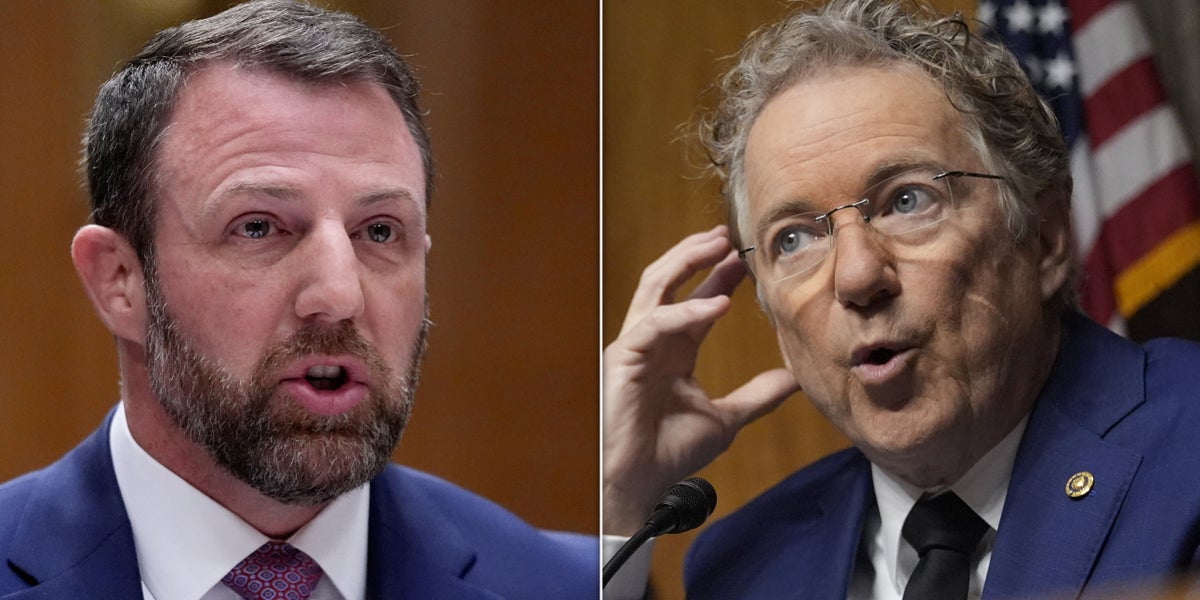
A Fiery Start: Rand Paul Challenges Markwayne Mullin's Conduct at DHS Hearing
The highly anticipated
markwayne mullin confirmation hearing for the critical role of Secretary of the Department of Homeland Security (DHS) kicked off with an unexpected and sharp rebuke from within his own party. Senator Rand Paul of Kentucky, the top Republican on the Senate Committee on Homeland Security and Governmental Affairs, wasted no time in confronting his fellow Republican, Markwayne Mullin, over concerns regarding his past conduct and what Paul termed "violent rhetoric."
The opening moments of the hearing were dominated by Paul's passionate address, emphasizing the imperative for national leaders to "disavow violence and lead by example." Paul drew a stark parallel to his own experience, recounting a violent attack that left him with six broken ribs – an incident that underscored his profound concern about the escalation of aggressive political discourse. He then directly challenged Mullin, accusing him of bragging about physical altercations and describing a recent personal interaction where Mullin had reportedly labeled Paul as "something of an elitist" for opposing a refugee welfare measure. This public airing of grievances, particularly from the head of the committee tasked with approving Mullin's nomination, immediately set a tense and confrontational tone for the proceedings. It highlighted the deep divisions and ethical considerations that sometimes transcend party lines, even when a president's nominee is from the same political camp. For any Cabinet nominee, maintaining a reputation for measured discourse and respect is paramount, especially for an agency as sensitive and impactful as DHS.
Mullin's Defense and the Path to Confirmation
In response to Senator Paul's pointed criticisms, Markwayne Mullin adopted a conciliatory yet firm stance. He acknowledged the personal differences between himself and Paul, stating, "We just don't get along." However, Mullin quickly pivoted, asserting his commitment to the job and his ability to compartmentalize personal disagreements from professional responsibilities. "Let me earn your respect. Let me earn the job. I won't fail you. I won't back down from a challenge. And I also admit when I'm wrong," Mullin declared, signaling a willingness to humble himself and demonstrate his leadership capabilities.
The dynamics of this exchange underscore a crucial aspect of the
markwayne mullin confirmation process: the need for consensus, or at least a lack of significant opposition, even from within one's own party. While Republican dissent might seem unusual for a Republican president's nominee, the Senate confirmation process demands a level of decorum and ethical standing that transcends strict party loyalty. Mullin's nomination must first clear the Homeland Security Committee, meaning he needs a majority vote from the very body Paul leads. If even a few Republicans on the committee side with Paul, it could significantly jeopardize his chances.
Practical Tip: For any presidential nominee, understanding the individual concerns and political leanings of key committee members, even those within their own party, is vital. Successful confirmations often hinge not just on policy alignment, but on personal relationships and a demonstrated capacity for bipartisan (or at least intra-party) cooperation and respect. Mullin's ability to assuage concerns like Paul's will be critical in demonstrating his fitness for a role that requires navigating complex political and operational challenges.
The Broader Context: Turmoil at the Department of Homeland Security
The significance of the
markwayne mullin confirmation extends far beyond the personal dynamic between two senators. Mullin is being tapped to lead a Department of Homeland Security currently in the throes of significant crisis and widespread criticism. His potential tenure would begin under immensely challenging circumstances that demand a leader capable of unity, decisive action, and delicate diplomacy.
The immediate backdrop to Mullin's nomination is the recent departure of former DHS Secretary Kristi Noem, who was reassigned by President Trump to serve as Special Envoy for The Shield of the Americas. Noem's tenure at DHS was marked by considerable turbulence, including an immigration enforcement surge in Minnesota that resulted in protests and the tragic deaths of two U.S. citizens. She faced bipartisan criticism for her handling of these events, as well as broader concerns about the department's spending and management of disaster relief efforts.
Adding to the complexity, the entire agency is currently shut down. Democrats have pushed for significant changes to how immigration officers operate, leading to a stalemate that has furloughed or left working without pay over 100,000 employees. This includes personnel critical to national safety and infrastructure, such as those in the Transportation Security Administration (TSA) and the Federal Emergency Management Agency (FEMA).
Insight: Leading DHS at this juncture requires not just policy acumen but an extraordinary ability to inspire confidence, manage diverse agencies, and rebuild trust, both internally and externally. A leader's temperament and ability to foster unity are paramount, especially when addressing issues as contentious as immigration and national security. Mullin's past rhetoric and the recent confrontation with Senator Paul raise questions about how effectively he can unite a fractured agency and navigate highly sensitive public relations challenges. His
Markwayne Mullin's DHS Challenge: Fixing a Furloughed Agency would be immense.
The Ethics Question: Beyond the Hearing Room
While the reference context specifically mentions Mullin's "ethics track record" as a potential snag, the direct details are sparse beyond Paul's confrontation. However, the exchange with Senator Paul itself places Mullin's conduct squarely within the realm of ethical scrutiny. Ethical leadership in government, particularly for a Cabinet-level position, demands more than just adherence to rules; it requires a demonstrated commitment to integrity, sound judgment, and a respectful demeanor. For the head of DHS, an agency entrusted with protecting the homeland and upholding federal laws, these qualities are non-negotiable. The ability to maintain composure under pressure, to foster an environment of professional respect, and to model appropriate conduct are essential for effectively leading a diverse workforce and dealing with a wide array of stakeholders. Mullin's commitment to "admit when I'm wrong" could be a crucial component in navigating future ethical challenges and rebuilding trust.
Oklahoma's Political Ripple Effect: A Senate Seat in Play
Another significant consequence of Mullin's potential move to DHS is the vacuum it creates in his current role. The
markwayne mullin confirmation process has naturally opened up one of Oklahoma's coveted Senate seats, which he currently holds. This development has initiated a flurry of political activity in the Sooner State, with Governor Kevin Stitt now tasked with appointing a replacement for the remainder of Mullin's term, which spans nine months.
Governor Stitt has wasted no time engaging with key figures, including President Trump, to discuss potential appointees. In a public statement, Stitt expressed his appreciation for Trump's selection of Mullin and his commitment to making a "swift decision" once Mullin's confirmation is finalized. The governor has also met with Republican leaders in the Senate, signaling his intention to select a candidate who can "advance a conservative agenda in Congress." Stitt has explicitly vowed to appoint a "small-government conservative" to the position, emphasizing the importance of ideological alignment for the interim senator.
Analysis: The appointment of an interim senator is a powerful gubernatorial prerogative that can significantly influence the political landscape, even for a short period. This temporary appointee will immediately gain the advantages of incumbency, potentially positioning them favorably for the subsequent election to fill the seat for a full term. Stitt's choice will not only impact the legislative agenda but could also shape the future of Oklahoma's representation in Washington. For more insights on this, read
Oklahoma Senate Seat: The Fallout of Mullin's Cabinet Nod.
Conclusion
The
markwayne mullin confirmation hearing has proven to be a pivotal and contentious moment, not just for the nominee but for the broader political landscape. Senator Rand Paul's direct confrontation over ethics and conduct cast an immediate shadow, highlighting the critical importance of leadership temperament in an era of heightened political polarization. Mullin's ability to navigate these initial hurdles, demonstrate a capacity for unity, and convince the committee of his fitness for such a demanding role will be key to his success. Beyond the personal drama, his potential leadership of a Department of Homeland Security grappling with shutdowns, public criticism, and immense operational challenges underscores the high stakes of this confirmation. The ripple effects also extend to Oklahoma, where Governor Stitt's pending appointment for Mullin's Senate seat will further shape the state's political trajectory. As the confirmation process unfolds, all eyes will remain on Mullin, the DHS, and the implications for national security and political discourse.